AI-First Ride Intelligence
Designing a Conversational AI Co-Pilot that simplifies ride booking through natural conversations, reducing friction and making mobility more accessible for everyone.
Overview
Product Overview
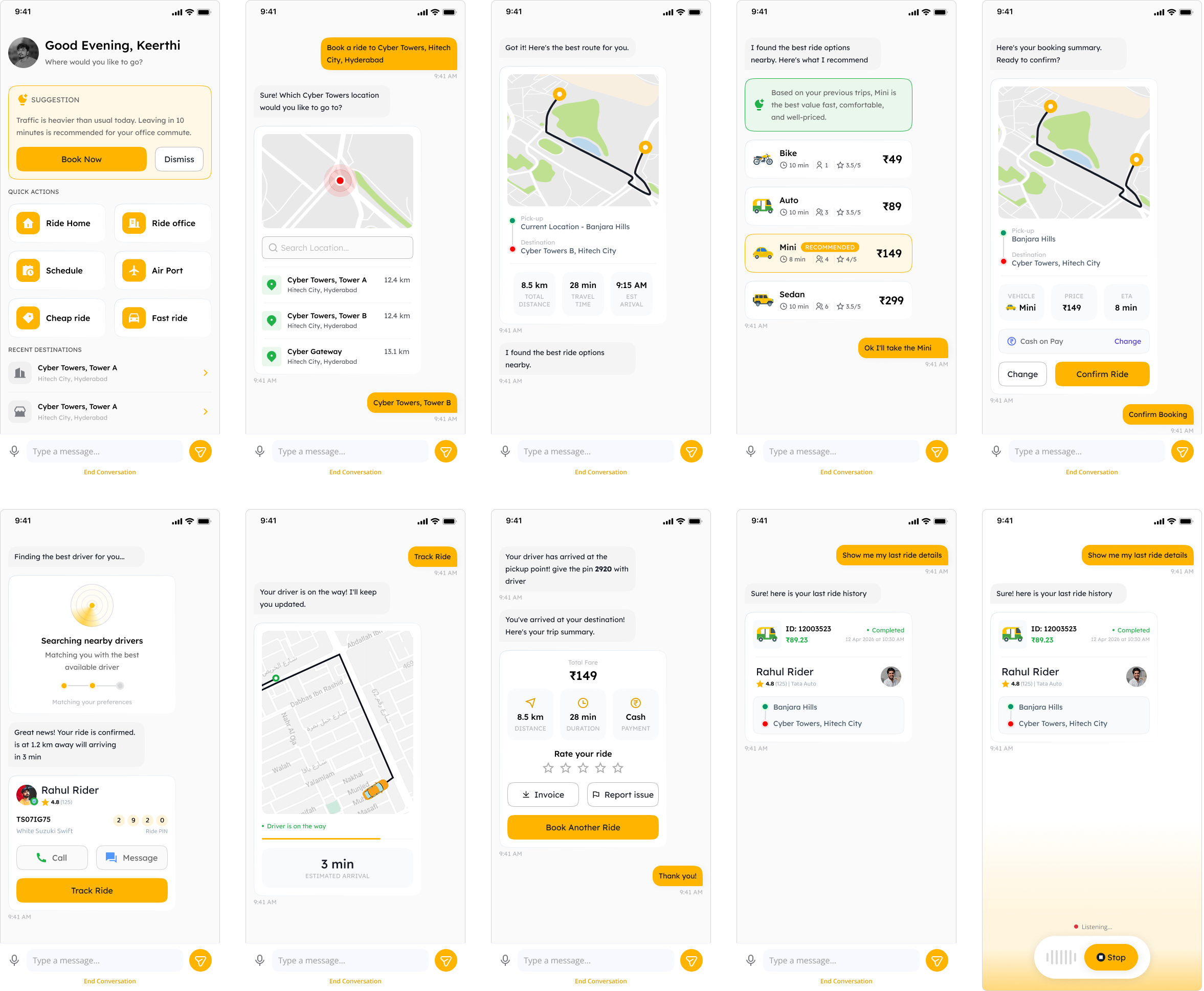
AI-First Ride Intelligence is a conceptual AI-powered feature designed for existing ride-booking platforms such as Uber, Ola, and Rapido. Instead of navigating through multiple screens, users can simply chat or speak naturally with an AI assistant to book rides.
The feature acts as a personal ride-booking co-pilot that understands user intent, finds the best route, compares ride options, applies relevant offers, tracks the ride, and keeps users updated throughout the journey.
The goal was not to redesign an entire ride-booking app, but to explore how Conversational UX and AI-powered interactions can simplify the ride-booking experience, especially for first-time users, elderly users, and people from Tier-2 and Tier-3 cities who may find traditional app navigation overwhelming.
Challenges
Identifying the Problem
While ride-booking applications have become part of everyday life, the booking process still requires users to perform multiple actions before confirming a ride. Through market research and observation of existing ride-booking experiences, I identified four key usability challenges
- 👉 Too many steps are required to complete a simple ride booking.
- 👉 Users need to compare ride categories, pricing, ETAs, and more manually.
- 👉 Digital literacy barriers make ride-booking apps difficult for many users.
- 👉 Information overload often leads to slower decision making.
- 👉 Limited accessibility for users who prefer regional language interactions.
- 👉 Traditional UI-heavy flows create unnecessary cognitive load.
Product Goals
Product Vision & Goals
- 👉 Transform ride booking into a natural conversation.
- 👉 Reduce friction and booking complexity.
- 👉 Improve accessibility through voice and text interactions.
- 👉 Minimize cognitive load through AI-powered recommendations.
- 👉 Support multilingual and regional language experiences.
- 👉 Create a scalable AI co-pilot model for future mobility platforms.
My Contribution
End-to-End Product Design Ownership
- 👉 Product strategy and concept creation.
- 👉 Conversational UX research and opportunity identification.
- 👉 User journey creation and experience architecture.
- 👉 AI workflow planning and prompt engineering.
- 👉 Wireframe generation and interaction design.
- 👉 High-fidelity UI design and refinement.
- 👉 Prototype development and validation.
Step-1
Research & Ideation
I began by researching current ride-booking experiences and exploring how Conversational UX could simplify mobility workflows. The research focused on identifying friction points in existing ride-booking applications, accessibility challenges, and opportunities where AI could assist users more effectively.
Using ChatGPT and Perplexity, I explored conversational interaction patterns, AI-assisted decision making, multilingual experiences, and emerging trends in mobility technology.
Step-2
User Journey Creation
Before designing the final experience, I mapped complete user journeys using ChatGPT and Whimsical. The goal was to understand how users would interact with an AI assistant throughout the ride-booking lifecycle.
This exercise helped define conversational touchpoints, booking flows, confirmations, ride tracking experiences, and post-ride interactions.

Step-3
AI-Assisted Wireframe Design
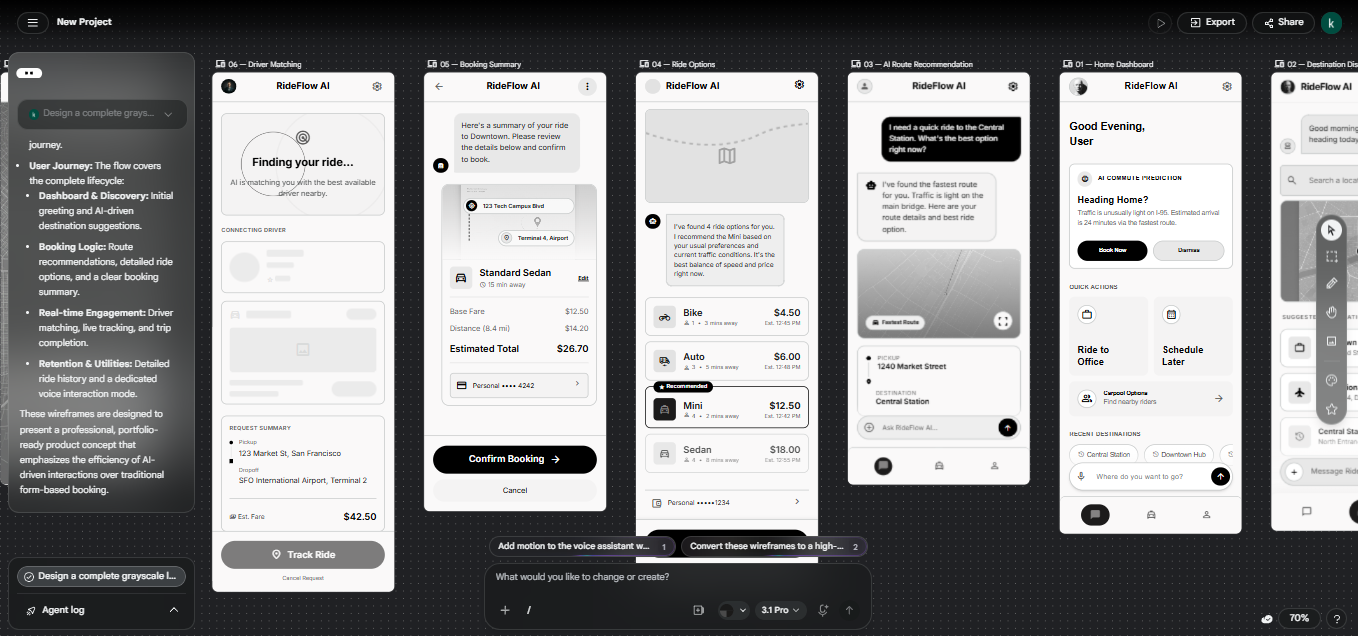
After validating the concept, I translated the initial ideas into wireframes using Google Stitch and UX Pilot. These AI-powered tools helped rapidly generate multiple layout directions and conversational interaction patterns.
The objective was to explore how users could complete ride-booking tasks through natural conversations while maintaining familiarity with existing mobility experiences.
Step-4
High Fidelity UI Screens using Figma
The generated UI screens were imported into Figma for refinement and final polishing. Visual hierarchy, spacing, typography, accessibility, and consistency were improved to create a production-ready experience.
This stage ensured the AI-generated output aligned with modern UX standards while maintaining a premium visual design language.
AI Tools Used
AI-Assisted Workflow
- ChatGPT + Perplexity — Research & Ideation
- ChatGPT — Prompt Engineering & Concept Development
- ChatGPT + Whimsical — User Journey Mapping
- Google Stitch + UX Pilot — Wireframes & UI Generation
- Figma — Design Refinement & Final Visual Design
- Base44 — Interactive Front-End Prototype
Future Scope
More Future Opportunities
- Personalized travel assistant based on user preferences.
- Predictive ride booking powered by behavioral insights.
- Multimodal transportation planning within a single conversation.
- Fully voice-driven ride-booking experiences.
- Hyper-localized support for regional languages and dialects.
Learnings
Key Takeaways
- People naturally think in intentions, not screens.
- Conversational UX can significantly reduce user effort.
- AI works best when it assists rather than replaces user control.
- Accessibility and inclusivity should be core design considerations.
- AI-assisted workflows can dramatically accelerate product design and prototyping.
